| The short
description!
.. with no medical terms ..
Carpal Tunnel
Syndrome is one of the more common examples of the (15+)
conditions that
are included under the umbrella term Repetitive Strain Injury. You may have heard the term before,
but in fact it only represents a small
but dangerous percentage of RSI problems.
It causes significant pain in
the wrist.
It often occurs in people who work with computers
or carry out repetitive manual
work with poor posture or activities that require you to work in an awkward position. Few
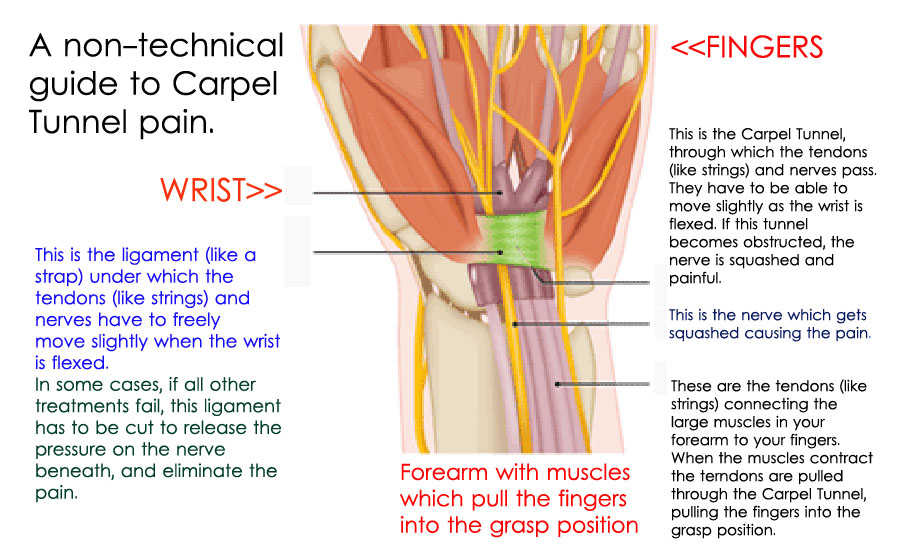
people are aware that the muscles which operate your fingers, to
provide the significant 'grip' which we all possess, are
actually positioned in the forearm. There are small muscles in
each finger, but these only provide a small amount of grip, and
are mainly used to 'ungrip' the fingers. i.e. pull the fingers
back after you have finished holding something, or move the
fingers sideways, or rotate the thumb. The
forearm is packed with large powerful muscles, and these are
linked to the fingers by tendons (like strong cables) which pass
through a hole or 'tunnel' in the middle of the wrist. So when
the muscles in the forearm contract, the tendons are pulled
through the carpel tunnel, and
as they are connected at the other end to the fingers, cause the
fingers to bend inwards and create the grip. It's an
extraordinary clever system which is now being copied by
engineers creating robotic hands. The
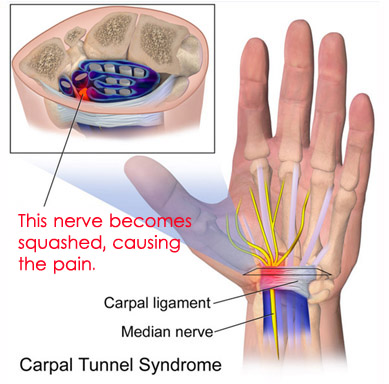
problem, however, is that there is also a nerve which passes
through the same tunnel, which controls the hand, and this can
become compressed due to several factors, causing the pain. One factor is the
repetitive use of the hand. What are the Symptoms?
 Tightness, discomfort, stiffness, soreness or burning in the hands, wrists, fingers, forearms, or elbows.
Tingling, coldness, or numbness in the hands.
Clumsiness or loss of strength and coordination in the hands.
Pain that wakes you up at night.
Feeling a need to massage your hands, wrists, and arms.
Pain in the upper back, shoulders, or neck associated with using the computer.
Causes
Repetitive
activities doing an activity that involves force, such as
lifting or carrying heavy objects.
Repetitive activities which are lightweight, but which subject
muscles to strain they are not used to, such as suspending the
hand and arm upwards for computer keyboard or mouse use.
Carrying out an activity for a long period of time without adequate rest periods
and poor posture.
Activities that require you to work in awkward or tiring
positions, and/or using vibrating equipment.
It
can come on quite suddenly, 'out of the blue' or gradually
increase over a long period. If you continue with your
activities and posture it will get worse and worse.
It may get so bad that you aren't able to do routine work or household activities.
The pain may get so bad that it's there all the time, even when you're resting.
|
The video below shows a dissection of an
actual human arm and wrist. This is the clearest way of showing how the muscles in the lower arm
and wrist function, and how Carpel Tunnel pain originates.
If
the video above does not run, click here to view an mp4 version
which should work on all devices

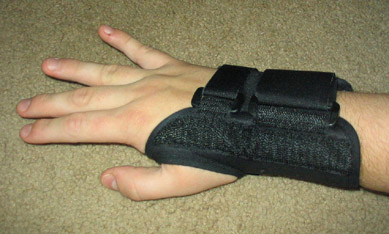
A
wrist splint. The splint prevents the wrist from bending, which
can place pressure on the median nerve and aggravate your
symptoms.

Scars
following surgery (above). This procedure is only normally carried
out if all other treatments have not been successful. Surgery is
normally successful.
|
|

The long description!
The rise of computer use and flat, light-touch keyboards that permit high speed typing have resulted in an epidemic of injuries of the hands, arms, and shoulders.
Use of pointing devices like mice and trackballs are as much
of a cause, if not more so. The thousands of repeated keystrokes and long periods of clutching and dragging with mice slowly
strains the arm muscles and eventually they react by becoming
very painful.
Carpal tunnel syndrome is a medical condition in which the median nerve is compressed as it travels through the wrist at the carpal tunnel and causes pain, numbness and tingling, in the part of the hand that receives sensation from the median nerve.
Pain may extend up the arm leading to discomfort extending to the shoulder and forearm. The mechanism of injury is compression; there are a variety of contributing
factors. Some of the individual predisposing factors include: diabetes, obesity, pregnancy, hypothyroidism, and a narrow-diameter carpal tunnel. CTS may also result from an injury that causes internal scarring or mis-aligned wrist bones. Occupational causes involve use of the hand and arm, such as heavy manual work, work with vibrating tools, and highly repetitive tasks even if they involve low force
motions.
The main symptom of CTS is intermittent numbness of the thumb, index, and middle (long) fingers and the radial (thumb) side of the ring
finger. The numbness often occurs at night, with hypothesized reasons related to sleep position, such as the wrists being held flexed during sleep or sleeping on one's
side.
Pain in carpal tunnel syndrome is primarily numbness that is so intense that it wakes one from sleep. Pain in electrophysiologically verified CTS is associated with misinterpretation of nociception and
depression.
People with CTS experience numbness, tingling, or burning sensations in the thumb and fingers, in particular the index and middle fingers and radial half of the ring finger, because these receive their sensory and motor function (muscle control) from the median nerve. Less-specific symptoms may include pain in the wrists or hands, loss of grip
strength, and loss of manual dexterity.
Some suggest that median nerve symptoms can arise from compression at the level of the thoracic outlet or the area where the median nerve passes between the two heads of the pronator teres in the
forearm, although this is debated.
Numbness and paresthesias in the median nerve distribution are the hallmark neuropathic symptoms
of carpal tunnel entrapment syndrome. Weakness and atrophy of the thumb muscles may occur if the condition remains untreated, because the muscles are not receiving sufficient nerve stimulation.
Most cases of CTS are of unknown cause. Carpal tunnel syndrome
can be associated with any condition that causes pressure on the
median nerve at the wrist. Some common conditions that can lead
to CTS include obesity, oral contraceptives, hypothyroidism,
arthritis, diabetes, prediabetes (impaired glucose tolerance),
and trauma. Carpal tunnel is also a feature of a form of Charcot-Marie-Tooth
syndrome type 1 called hereditary neuropathy with liability to
pressure palsies.
Other causes of this condition include intrinsic factors that
exert pressure within the tunnel, and extrinsic factors
(pressure exerted from outside the tunnel), which include benign
tumors such as lipomas, ganglion, and vascular malformation.
Carpal tunnel syndrome often is a symptom of transthyretin
amyloidosis-associated polyneuropathy and prior carpal tunnel
syndrome surgery is very common in individuals who later present
with transthyretin amyloid-associated cardiomyopathy, suggesting
that transthyretin amyloid deposition may cause carpal tunnel
syndrome.
The median nerve can usually move up to 9.6 mm to allow the
wrist to flex, and to a lesser extent during extension.
Long-term compression of the median nerve can inhibit nerve
gliding, which may lead to injury and scarring. When scarring
occurs, the nerve will adhere to the tissue around it and become
locked into a fixed position, so that less movement is apparent.
Normal pressure of the carpal tunnel has been defined as a range
of 2–10 mm, and wrist flexion increases this pressure 8-fold,
while extension increases it 10-fold. Repetitive flexion and
extension in the wrist significantly increase the fluid pressure
in the tunnel through thickening of the synovial tissue that
lines the tendons within the carpal tunnel.
Treatment
Like other forms of RSI,
in non-specific terms:
- Stop the activity which
caused the problem in the first place.
- Exercise to relax and assist
the recovery of muscles, tendons and ligaments.
- Prescriptions of
anti-inflammatory drugs and pain killers. Sometimes Steroids.
- In extreme cases surgery may
be necessary.
Scars
following surgery (above) this procedure is only normally
carried out if all other treatments have not been successful.
Surgery is normally successful.
More specifically
Treatment for carpal tunnel
syndrome (CTS) depends on the severity of the condition and how
long you have had it.
In some cases, CTS will improve after a few months without
treatment. Moving your hand or shaking your wrist can often help
relieve the symptoms.
You should try avoid any activites that make your symptoms
worse.
If you work with computer keyboards, there is little evidence
that modifications at your workplace are likely to be of any
help in relieving your symptoms.
If symptoms persist, there are a range of non-surgical and
surgical treatments available that aim to relieve the pressure
on the median nerve.
If your CTS is caused by an underlying health condition such as
rheumatoid arthritis, treating the condition should improve your
symptoms.
Read on to learn about the different treatments you may be
offered. You can also see a summary of the pros and cons of
these treatments, which allows you to easily compare your
options.
Non-surgical treatments
Unless there is thought to be an immediate need for surgery,
treatments such as wrist splints and corticosteroid injections
are often recommended initially.
There is a lack of evidence to support the use of non-steroidal
anti-inflammatory drugs (NSAIDs) such as ibuprofen for treating
CTS, or for diuretics to help relieve fluid retention.
Wrist splints
A wrist splint is worn to support the wrist and keep it in a
neutral position. It should not apply direct pressure over the
carpal tunnel.
The splint prevents the wrist from bending, which can place
pressure on the median nerve and aggravate your symptoms.
You should begin to notice an improvement in your symptoms
within four weeks of wearing the wrist splint. Wrist splints are
usually available from larger pharmacies, or your GP may be able
to recommend a suitable supplier. They can also be ordered
online.
Corticosteroids
Corticosteroids are a type of steroid medication. Steroids are
hormones that are naturally produced in the body. They are
powerful chemicals that can help reduce inflammation.
If a wrist splint does not work, corticosteroids may be
recommended.
Corticosteroids can be taken as tablets, although for CTS it is
likely that you will have a corticosteroid injection directly
into your wrist.
One injection is usually recommended to begin with. If the
condition responds well to one injection but then recurs, the
treatment may be repeated.
Carpal tunnel release surgery
Surgery is usually recommended for cases of CTS, when other
treatments have failed to relieve symptoms.
Surgery for CTS is known as carpal tunnel decompression or
carpal tunnel release surgery and is performed on an outpatient
basis, which means you will not have to stay in hospital
overnight.
During surgery the roof of the carpal tunnel, known as the
carpal ligament, is cut to reduce pressure on the median nerve
in the wrist.
A local anaesthetic is used to numb your hand and wrist, but you
will remain awake throughout the operation.
The surgery can be performed as open surgery, which involves
making a single cut in the wrist, and is the traditional type of
operation.
Some surgeons use keyhole surgery, where special instruments and
a long tube with a light at one end and an eyepiece at the other
are inserted through small cuts in your wrist, and sometimes
your palm. This allows the surgeon to see the carpal ligament on
a monitor throughout the operation.
There are no long-term differences in the outcomes of the two
approaches.
Your surgeon will be able to discuss the most appropriate method
of surgery with you.
Things to consider
A number of things may affect your decision to have surgery.
These include:
- possible complications after surgery (see below)
- the recovery time
- how successful non-surgical treatments have been
In most cases, carpal tunnel release surgery provides a complete
and permanent cure. However, as with any form of surgery there
is always a small risk of complications.
Reported complications of CTS include:
- infection
- failure during surgery to fully separate the roof of the
carpal tunnel, usually resulting in persistent CTS symptoms
- bleeding after the operation
- nerve injury
- scarring
- persistent wrist pain, which may be different to the original
symptoms
- in rare cases, the return of CTS symptoms long after
apparently successful surgery
- complex regional pain syndrome – a rare but chronic
(long-term) condition that causes a burning pain in one of the
limbs
After surgery
Following carpal tunnel release surgery, your hand will remain
in a bandage for a couple of days and you may need to wear a
sling. You should keep your hand raised for 48 hours to help
reduce any swelling and stiffness in your fingers.
To help prevent stiffness, gently exercise your fingers,
shoulder and elbow. You may be able to start these gentle
exercises on the day of your operation.
After having surgery for carpal tunnel syndrome (CTS), you can
use your hand to do light activities that do not cause excessive
pain or discomfort. Try to avoid using your hand for more
demanding activities until it has completely recovered, which
may take several weeks.
The recovery time for open release surgery is usually slightly
longer than the recovery time for keyhole surgery. Studies have
also shown that there is less pain during the first three months
after keyhole surgery compared with open release surgery.
However, both methods have proven to be equally effective in
treating CTS.
CTS during pregnancy
If you develop CTS during pregnancy, your symptoms should pass
after your baby is born (after about six to 12 weeks).
However, if the median nerve is severely compressed (squashed)
or if the symptoms of CTS are chronic (long-lasting), permanent
nerve damage and muscle-wasting can occur and treatment will be
required.
Useful products:
See
Flextend
|
|